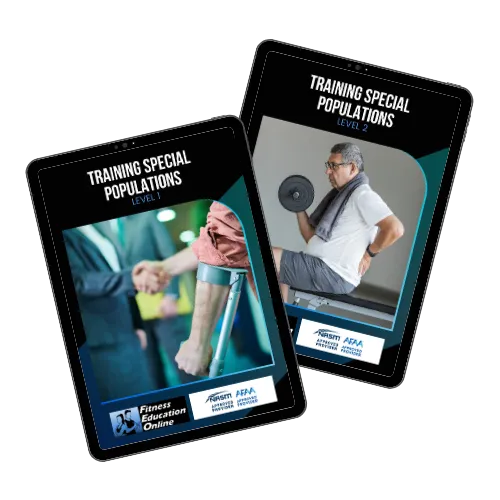
Training Special Populations Package
Course Details:
♦ 100% online.
♦ No time limit.
♦ Approx 10-20 hours of coursework.
♦ Assessment is multiple choice (no video).
♦ CECs and completion certificate delivered within 24 hours of completion.
♦ Lifetime access to all coursework.
Course is registered with NASM (2CEUs) and AFAA (2CEUs).
Curriculum
Training Special Populations Level 1
Module 1: Duty of Care
Learn the essential responsibilities and ethical considerations of providing fitness training to individuals with special needs, ensuring their safety and well-being.
Module 2: Training People with Arthritis
Discover strategies for effectively training clients with arthritis, including modifications and exercises that accommodate their condition.
Module 3: Training People with Osteoporosis
Explore exercise techniques and program design for clients with osteoporosis, focusing on bone health and injury prevention.
Module 4: Training People with Autism
Understand how to adapt training programs to meet the needs of clients with autism, including communication and sensory considerations.
Module 5: Training People with Back Pain
Learn how to create safe and effective fitness programs for clients dealing with chronic back pain, incorporating appropriate exercises and modifications.
Module 6: Training People with Cancer
Get insights into designing fitness programs for clients undergoing cancer treatment, focusing on support and adaptation to their changing needs.
Module 7: Training People with Diabetes
Discover how to manage and train clients with diabetes, including exercise considerations for blood sugar regulation and overall health.
Module 8: Training People with Cardiovascular Disease
Explore exercise guidelines and program modifications for clients with cardiovascular disease, prioritizing safety and heart health.
Module 9: Training People with Parkinsons
Learn effective training approaches for clients with Parkinson’s disease, including strategies to improve mobility and manage symptoms.
Module 10: Training People with Mental Health Conditions
Understand how to support clients with mental health conditions through fitness, focusing on exercises that promote mental well-being and stability.
Module 11: Training People with Respiratory Conditions
Discover how to tailor fitness programs for clients with respiratory conditions, ensuring exercises are safe and beneficial for their respiratory health.
Training Special Populations Level 2
Module 1: Theory
Review the boundaries and ethical considerations for fitness professionals when working with advanced special populations.
Module 2: Duty of Care
Revisit the principles of duty of care, focusing on advanced considerations for ensuring client safety and effective support.
Module 3: Training People with Dementia
Learn specialized techniques for training clients with dementia, including methods to enhance engagement and manage cognitive challenges.
Module 4: Training Older Adults
Explore advanced strategies for working with older adults, including exercise modifications and program design to support their unique needs.
Module 5: Training People with Spinal Cord Injuries
Discover how to design and implement fitness programs for clients with spinal cord injuries, focusing on mobility and adaptive exercises.
Module 6: Training People with Intellectual Disabilities
Learn effective training approaches for clients with intellectual disabilities, including communication strategies and program adaptations.
Module 7: Training People with Eating Disorders
Understand how to safely and effectively support clients with eating disorders through fitness, focusing on promoting healthy habits and body image.
Module 8: Training People who are Obese
Explore strategies for working with obese clients, including program design that promotes weight loss, fitness, and overall health.
Module 9: Exercise Guidelines for Training Pregnant Women
Get comprehensive guidelines for designing exercise programs for pregnant women, focusing on safety and effective prenatal fitness.
Module 10: Exercise Guidelines for Training Post Natal Women
Learn how to create fitness programs for post-natal women, addressing recovery and rebuilding strength after childbirth.
Module 11: Training Menopausal and Peri Menopausal Women
Discover how to tailor fitness programs for women undergoing menopause and peri-menopause, focusing on symptom management and overall health.
Module 12: Training Clients with Invisible Illnesses
Understand how to support clients with invisible conditions, including strategies to accommodate and address their specific needs without visible symptoms.
Training Special Populations Package
Course is registered with NASM (2CEUs) and AFAA (2CEUs).
$199 SGD
Delivery Method
Overview
All courses are delivered 100% online and completely self-paced, giving you the flexibility to study around your own schedule.
Course Content
All course components are completed through our interactive online learning platform. Content is delivered via video lectures, powerpoint presentations, online eBooks and audio books — so you can learn in the style that suits you best. You can log in anytime, from anywhere, to work through the material.
Assessments
Assessments are all multiple-choice questions designed to test your knowledge and application. You have unlimited assessment attempts so even if you don’t pass the assessment at first chance, you can resubmit at no extra cost.
Completion Certificate
On completion of your assessment you will automatically receive your completion certificate and CEUs.

What Support is Available?

Email to Support Team
If you encounter any technical issues or have general questions about the course, you can reach out to our dedicated support team. We’re here to assist you with any concerns you may have, ensuring a smooth learning experience.
Email to Course Presenter
For course-specific questions, you can directly email the course presenter. Whether you need clarification on the material or advice on applying the concepts, the presenter is available to guide you through the content. Contact details will be provided within the course materials.
Access to a Private Facebook Group
Join our Facebook group for course participants, where you can connect with peers, share insights, and ask questions. The group is a supportive community where both fellow students and course instructors are active, offering additional tips and encouragement as you progress.